Forming the base
Organic lenses use casting or injection moulding, depending on the polymer. Mineral glass follows its own forming and finishing route. The base defines geometry, weight and optical properties.
SUN LENSES · BEFORE THE FINAL SHAPE
Our focus is the lens. Its material, colour, surface and the way it transmits light. BAHN d.d. is a family business in Trzin, Slovenia, focused on manufacturing lenses for sunglasses.
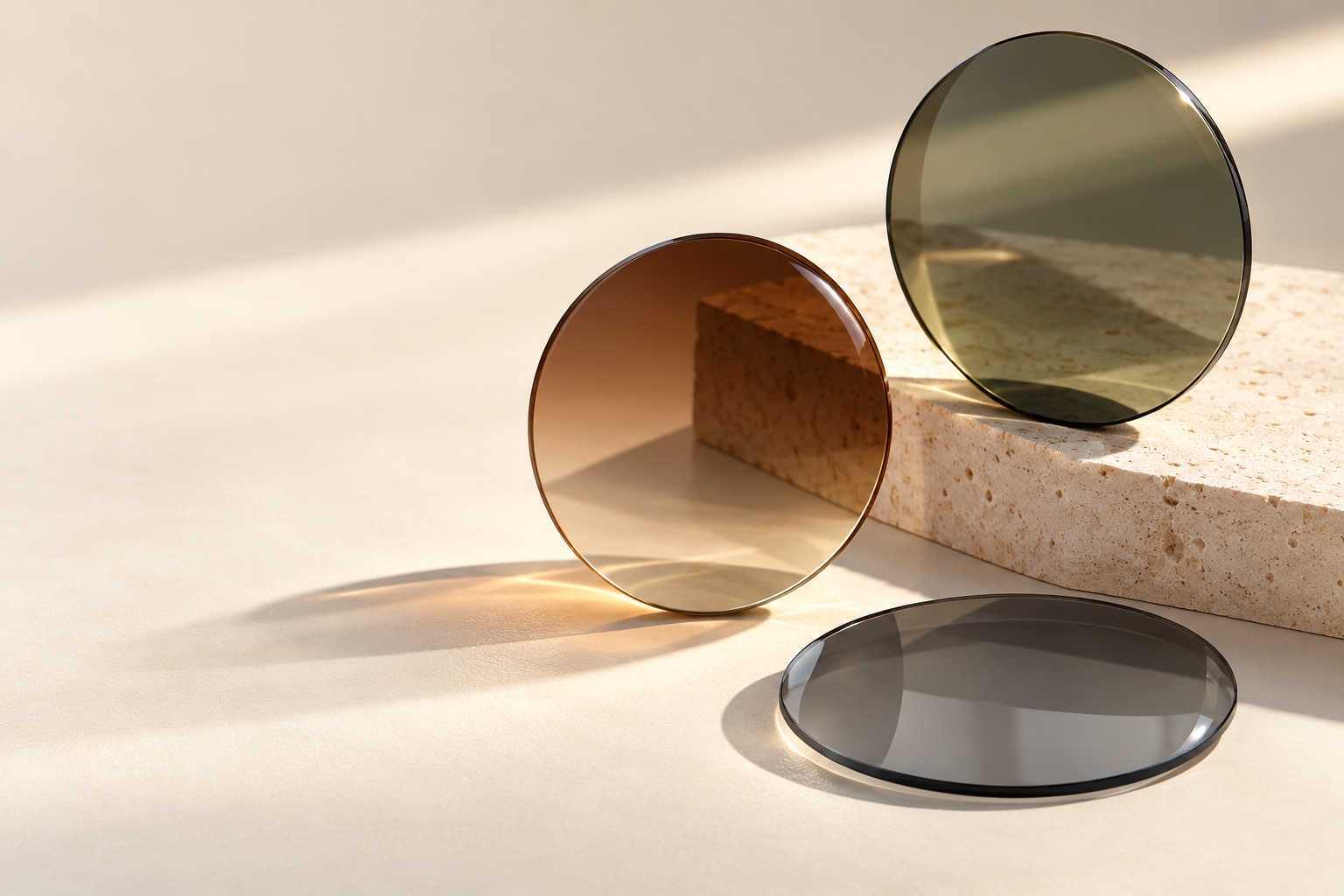
Explore the technology↗Concept visualisation of uncut sun lenses
BAHN / 0101 / IT STARTS WITH LIGHT
Before a lens takes the shape of a frame, it acquires its essential properties. Material, geometry, filtration and surface treatments shape its future application.
An uncut lens is usually a circular optical element awaiting edging and mounting. It is not necessarily the same as a semi-finished prescription blank that still needs optical surfacing. Our overview focuses on non-prescription sun lenses.
This technology guide describes industry options. Availability of each material, process and specification at BAHN is confirmed upon enquiry.
02 / FROM MATERIAL TO LENS
The production route depends on the material and product requirements. Not every process suits every combination.
Organic lenses use casting or injection moulding, depending on the polymer. Mineral glass follows its own forming and finishing route. The base defines geometry, weight and optical properties.
Solid tints, gradients and absorptive additives influence visible light. UV filtration is a separate property: a darker tint alone does not establish stronger UV protection.
Polarising elements reduce selected reflections. Hard coats, anti-reflective, mirror and finishing treatments complement the base where technically compatible.
Optical quality, spectral transmission, surface condition, dimensions and batch consistency matter. Final edging follows the chosen frame geometry.
IN FOCUS / POLARISED SUN LENSES
Polarisation adds a distinct function to a sun lens: reducing glare from selected reflections. Performance starts with the lens structure, before it is edged to fit a frame.
A polarising element selectively transmits light according to its direction of oscillation. Its orientation and integration with the lens material are essential to the final optical result.
Material compatibility, alignment and coating quality must be considered together.
A useful specification defines transmission, polarisation performance, colour consistency and surface quality.
Polarisation and UV protection are different properties. Compatibility with displays and intended use should be checked for the selected lens. Contact BAHN to discuss available specifications.
Discuss polarised lenses ↗03 / MATERIALS
Selection balances optical quality, weight, durability, geometry and treatment compatibility.
An established optical polymer, generally formed by casting. It supports a range of tints and surface treatments.
A lightweight material with high impact resistance. Production requires control of internal stress and surface quality.
A thermoplastic sun lens base combining low weight, design flexibility and treatment options.
Optical glass with characteristic surface hardness. Selection must consider its higher weight, breakage behaviour and safety requirements.
04 / COLOUR & FUNCTION
Explore the appearance of tint families. This is a design simulation, not a transmission measurement or an available-product catalogue.
A neutral visual direction with a restrained, contemporary character.
Reduces glare from selected reflections off roads, water and other surfaces. Polarisation is not the same as UV protection.
Variable tint depending on activation conditions. Response depends on technology, temperature and light; behaviour behind a windscreen may differ.
Improves surface scratch resistance. Coated lenses still require appropriate cleaning and handling.
Anti-reflective treatment reduces reflections at the treated surface. Mirror coatings create a different reflective and aesthetic effect.
A finishing layer that reduces surface wetting by water and can make cleaning easier.
A surface treatment that helps remove oily marks. Performance and durability depend on the coating system.
05 / QUALITY & STANDARDS
Verifiable specifications matter in the eyewear industry. A lens blank and finished sunglasses are different product stages: final conformity must take intended use and construction into account.
Requirements for sunglasses for general use. The baseline is the 2022 edition with Amd 1:2026. The applicable European version and harmonisation status also need to be considered.
Reference test methods for determining properties of sunglasses and related eyewear.
The European framework for personal protective equipment. Final products require appropriate conformity assessment, documentation, labelling and instructions.
References to standards are informational and do not claim certification of BAHN or any individual product.
06 / A FAMILY BUSINESS
BAHN d.d. is a family business in Trzin, with a story that continues from one generation to the next. Katarina Bahn took over the company from her father and expanded its production capacity. Sunglass lenses and expertise in materials, light and precision manufacturing remain at its heart.
The year 2026 opens a new chapter: BAHN is exploring new directions and planning a merger with GLAZEX. This marks a new stage in the development of the family business. Contact us directly to discuss cooperation and future opportunities.

07 / FINAL APPLICATION
The frame defines the silhouette. The lens adds colour, reflection and optical function. This design study illustrates one possible aesthetic direction for sun lens applications.
AI design study. Not a product offered for sale.GOOD TO KNOW
No. In everyday optical terminology, the word can also refer to organic polymer lenses. A technical enquiry should always identify the actual material.
Its edge needs to be shaped to the frame before mounting. Further processing and checks depend on the supplied production stage and final construction.
No. Visible-light attenuation and UV filtration are different properties. They are established through data and testing, not appearance.
The term refers to filtering UV radiation up to the 400 nm region. Specific claims require appropriate measurement; the label alone does not replace conformity evidence.
No. Compatibility between the substrate, polarisation, tint and coatings must be checked for the specific design.
Intended use, preferred material, diameter, base curve, colour, filtration, coatings, estimated quantity and target market. If you do not have a specification yet, describe your project.
LET’S START WITH YOUR IDEA
Developing a collection or exploring sun lens options? Send us your initial requirements and ideas.
info@bahn.si ↗Industry technology and standards overview, checked October 2026. Links do not imply a business partnership.
This website uses no analytics or advertising cookies. Enquiries are sent through your email application; the information in your message is used to reply. The server may record technical access data. For privacy questions, contact info@bahn.si.